Briefi for mortgage brokers

Every loan you have written, and the day its fixed rate ends.

For mortgage and finance brokers. Briefi prepares and writes up your client meetings, keeps a register of every loan a household holds, lays out the work for the three months before a fixed rate ends, and gets the Credit Guide, consents and fees signed.

From A$69 a monthAdvisor Start, one seat
14-day free trialon every plan
Never a bare statuseach one dated when it was confirmed
Two people going through a printed document together in a bright office.
How a client file moves

From the first call to the signed copy, on one record.

  1. BriefBefore you meet: the loans on record, and any fixed rate about to end.
  2. MeetingCaptured and transcribed, with repayment and borrowing calculators beside your notes.
  3. RecapDecisions and actions with an owner, and a follow-up drafted for you to check.
  4. FormThe next step goes out: a fact-find, a document request or the fixed-rate check-in.
  5. Signed and filedEach applicant signs. The signed copy is filed to the household.
The meetings you run

Four kinds of client meeting, and what comes after each.

Every meeting gets a brief before and a recap after: decisions, actions with an owner, and a follow-up drafted for you to check and send, filed to the household. What differs is the next step.

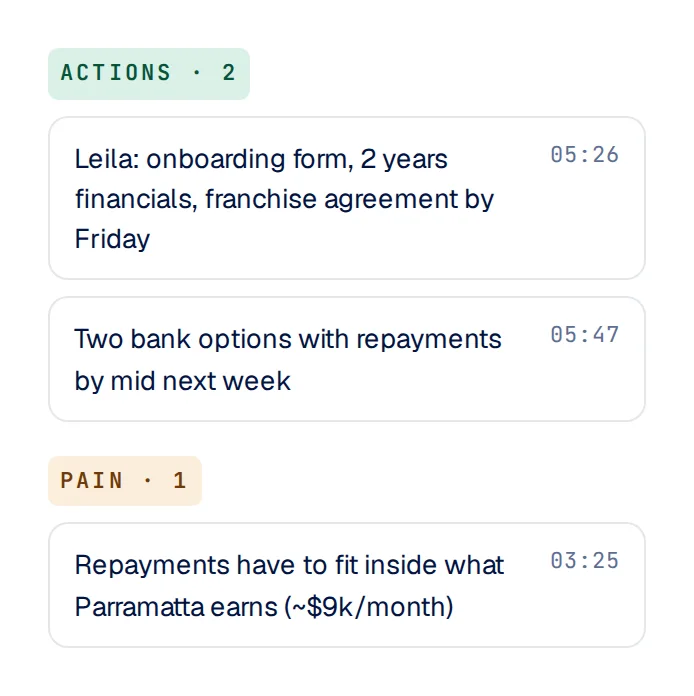
Recap highlights from a franchise funding call: two actions, each with the minute it was agreed, and one concern, that repayments have to fit what the site earns.

Real screen from a demo workspace: a franchise funding call. Names are fictional.

MeetingBeforeAfter
Initial consultationNew client journey
BeforeThe Credit Guide, privacy consent and fees go out in one link, to sign in the same week.
AfterNext on the journey: the fact-find, then income, bank statements and ID from the client.
Going through the recommendationAfter the assessment
BeforeThe fact-find answers and every document provided, on one record.
AfterLodge the application and record it on the loan register, due within 5 days.
Fixed rate options30 days before it ends
BeforeWhat the client told the check-in: refix, go variable or refinance, and for how long.
AfterTheir instruction is due 14 days before the rate ends, and the new rate goes on the loan.
Annual loan reviewYearly, from 30 days before
BeforeAn optional check-in goes to the client 21 days ahead, and each loan is compared against the market.
AfterUpdate the loan register within 7 days. The next review is counted from this one.

Plenty of a broker’s meetings are with lenders, your aggregator or your own staff. The brief names loans and fixed-rate dates only when the meeting is about a client’s lending.

The loan register

One household. Every loan it holds, and where each one stands.

The household is who you look after. Each loan inside it has its own status, rate and dates, so the record keeps both.

  • Every loan, topline. Lender, loan type, purpose, security, amount and rate, whether it is fixed, variable or split, the repayment, and the dates that matter: settlement, the fixed rate ending and maturity.
  • Never a bare status. “Settled” always comes with the date somebody last confirmed it, and one nobody has confirmed for 12 months reads as stale, whatever it says.
  • A passed date is flagged, not rolled forward. A fixed rate that ended with nobody updating the loan shows the record as out of date rather than carrying the old rate on.
  • What needs doing, on the record. A loan settling within 14 days, or a fixed rate ending within 90, shows at the top of the client’s record.
What Briefi cannot see

A lender’s portal. Approval, settlement and a new rate are what your team records on the loan, and a journey step waiting on a lender says so. The lender’s statement stays the authority on the balance and the rate.

JourneyFixed rate ending · Haddad household home loan

Three months of work in front of a fixed rate ending, laid out from the date back.

  • Dated from 90 days out, for every settled fixed or split loan on the register. Open the client’s record inside that window and the journey is already laid out.
  • Each step says whose move it is: yours, the client’s, a form, a meeting or the new rate on the loan.
  • Journeys for the broking year: a new client from the first conversation to settlement, the fixed rate ending, and the annual loan review.
The broker’s year

One household’s year, read off the register.

Every date the register holds for the Haddad household from July to June, beside the meetings you hold with them.

Sample data, drawn. The fixed-rate journey is dated from 90 days before the date on the loan; the annual review is counted from the last one.

Forms, documents and signing

The Credit Guide and consents first. Then the documents, then the signatures.

Forms open in a phone browser with no app to install, and each applicant signs for themselves.

  1. Getting started with a loan

    Credit Guide, privacy consent and fees, in one link.

    Sample data, drawn.

  2. Income, statements and ID

    Your team accepts or waives every file asked for.

    Sample data, drawn.

  3. Each applicant signs

    A second applicant or guarantor signs for themselves.

    Sample data, drawn. Names are fictional.

  4. A portal for the household

    Clients see their loans and what they owe you, and upload it.

    Sample data, drawn. The portal never shows a balance: the lender’s figure is the live one.

Who is holding up the file

See which clients answer, and how fast.

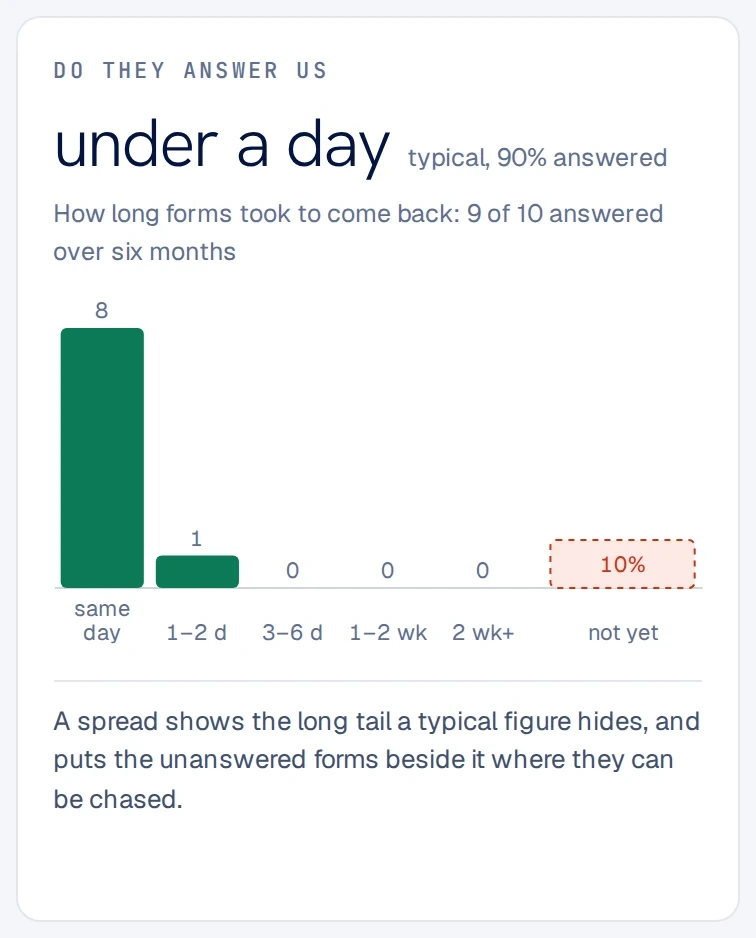
Insight counts how quickly clients return what you send them, from forms actually sent and returned. Every figure has rows behind it.

  • What is waiting on the client, and what you owe them, counted on every record.
  • Support staff on free seats on Advisor Solo and Advisor Practice, so a loan processor or assistant can chase documents without a paid seat.
  • Reminders by text as well as email, for a form, a document or a signature still owed, sent from a shared number with your firm’s name at the start. From 25 texts a month on the Advisor plans.
Insight card, Do they answer us: forms typically come back in under a day, 90 percent answered, 9 of 10 over six months.

Real screen from a broking demo workspace.

Handling client lending records

What the record holds, and what it leaves out.

What we can state plainly, because it is true of every workspace today.

  • Never a balance on the portal. A client sees each loan, its rate and its status with the date it was confirmed. A balance typed in months ago is left off.
  • Your workspace’s own key. Briefs, recaps, transcripts and your notes on each loan are encrypted with it.
  • Uploads kept only as long as stated. The removal date is on the upload page, and files are deleted on it.
  • Nothing guessed from a lender. An approval, a settlement or a new rate is on the record because a person on your team put it there.

Briefi keeps the record of what each client borrows and what is coming up. The recommendation, your best interests duty and your obligations under your credit licence stay with you.

Read the security overview
Pricing

The loan register comes with every Advisor plan.

Billed each month. Switch to annual for a lower rate.Billed each month. Switch to annual for a lower rate.

Advisor Start

A$69A$49/mo

A sole broker with a small book.

  • 1 seat
  • 50 clients on file, 10 active a monthLaunch allowance25 on file, 5 active a month after the launch offer
  • 5 recording hours and 1,500 credits a month
  • Loan register, journeys, signing and the client portal
Start free trial

Advisor Solo

A$89A$69/mo

A sole broker with a loan processor or assistant.

  • 1 seat and a free support seat
  • 500 clients on file, 50 active a monthLaunch allowance250 on file, 25 active a month after the launch offer
  • 10 recording hours and 4,000 credits a month
  • Client portal on your own briefi.sh address
Start free trial

Advisor Practice

A$249A$199/mo

A broking practice with a team.

  • 4 seats and 4 free support seats
  • 2,000 clients on file, 200 active a monthLaunch allowance1,000 on file, 100 active a month after the launch offer
  • 40 recording hours and 12,000 credits a month
  • Client portal on your firm’s own domain
Start free trial

Kept for as long as you stay subscribed. For the first 100 workspaces or until 31 December 2026, whichever comes first.

On file, and active

On file is everyone in your record, with a household counted once. Active is who you did work for that month, averaged over three months.

Which plans include it

The loan register and journeys are on every Advisor plan, and on Scale and Enterprise. Meetings plans and Briefi Sign do not include them.

14-day free trial. AUD prices include GST for Australian customers. Your currency is detected at checkout.Compare Advisor plans
Questions

What brokers ask first.

Does Briefi connect to lenders or our aggregator’s software?

No. Briefi cannot see a lender portal or your aggregator’s systems. Your team records each loan, its status and its dates, and every status shows the date somebody last confirmed it. A journey step that waits on a lender says so.

Which forms come ready to send?

Four, written for a broker, and yours to copy and change. Getting started with a loan: the Credit Guide, privacy and credit reporting consent, and the fees and commission disclosure in one link, with a second applicant or guarantor signing where there is one. You complete the Credit Guide and commission wording before it goes out. The finance fact-find: what they want, income, assets and debts, any decline in the last 12 months, and defaults or arrears. Your fixed rate is ending: refix, go variable or refinance, and for how long. The annual loan review check-in: anything coming up in the next year.

How do document requests work?

Ask the client, or their accountant by upload link, for exactly the files you need, or start from the home loan application or self-employed income list. Zipped folders are unpacked, and each file is accepted, or marked not needed, by a person on your team.

Can I run the numbers during the call?

Yes. In a broking workspace the meeting page has calculators beside your notes: repayments, a rough borrowing estimate, a comparison of up to three lenders, and LVR with usable equity. A lender’s advertised home loan rate can be looked up and changed to the rate you were given. Every figure is an estimate for the conversation, not a lender’s assessment, and Add to notes puts a one-line summary in the meeting notes.

Does it help with the best interests duty?

It keeps the evidence on one record, dated: the fact-find answers, the documents provided, what the client said mattered in the meeting, and the options you went through. The recap keeps what a client evidenced apart from what they estimated. Whether a loan is in the client’s best interests is your judgement, and Briefi does not make it.

When does the fixed-rate work start?

Ninety days before the end date on the loan, for every settled fixed or split loan. Open the client’s record inside that window and the journey is there, with each step dated back from the end date, from the client check-in at 75 days to the new rate going on the loan. A date that passes with nobody updating the loan shows the record as out of date.

Does it check a client’s identity?

Not yet. Identity checks are coming soon. Today you can ask for ID documents in a document request, and a person on your team accepts each one.

Can loan processors and assistants use it?

Yes. Advisor Solo includes one free support seat, and Advisor Practice includes one for each paid seat, four to start.

Does it work outside Australia?

Meetings, recaps, forms, signing and the client portal work anywhere, and so do the repayment, comparison and equity calculators. The broking forms, the borrowing estimate and the rate look-up are Australian, so today they are built for Australian brokers. Versions for other countries are planned.

Bring a household with a fixed rate ending. We will show you its next three months.

A 30-minute demo, set up as a broking practice, around a client like one of yours.